
When I ask new students what they would like to achieve with their Spanish, one answer comes up again and again:
“I just want to speak fluently.”
Sometimes they have been learning Spanish for months with apps. Others have studied for years and can already read a book or watch a film without too much trouble.
And yet, when someone asks them a simple question in Spanish, they freeze.
They know the words. They understand the question. But somehow, the answer doesn’t come out.
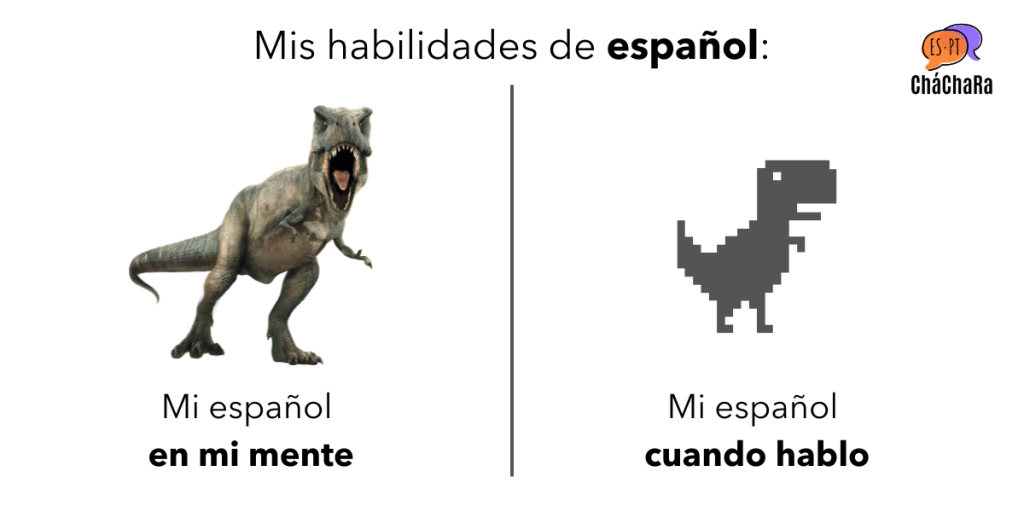
If this sounds familiar, there is nothing strange about it. Understanding a language and producing it are related skills, but they are not exactly the same skill.
Your Spanish doesn’t have just one level
We often talk about our language level as if it were a single number: “I’m B1” or “I have a B2.”
In reality, your skills can develop at different speeds.
You might have a B1 level when you read, for example, but feel closer to A2 when you speak. You may understand most of what someone says to you but still need a long time to build your own sentences.
And that’s OK.

Recognising a word when you hear it is much easier than finding that same word yourself, putting it into a sentence and saying everything quickly enough to keep a conversation going.
To get better at doing that, you have to practise producing the language.
Unfortunately, there is no way around speaking
Watching series, listening to podcasts, reading and using language-learning apps can all help you build your Spanish.
But if your main goal is to speak, at some point you have to practise exactly that.
When you speak, your brain has to do several things at once: decide what you want to say, find the vocabulary, choose a grammatical structure and pronounce everything – while you feel the stare of another person waiting for your answer.

At first, that process can feel painfully slow.
The good news is that it becomes more automatic with practice.
And this is also why repeating yourself can actually be useful. Tell a story once and you may hesitate constantly. Tell it again after noticing some missing vocabulary or receiving feedback, and suddenly the words start coming more easily.
Speak → notice → adjust → try again
That cycle is much more useful than waiting until you feel “ready” to speak.
But what about the mistakes? I don’t want to make mistakes!
Oh, but you will.
We all do too when we’re learning new languages.
One of the biggest barriers I see in students is not a lack of vocabulary or grammar, but the fear of using what they already know because they might use it incorrectly.
The problem is that trying to avoid every mistake can make speaking even harder. You start checking the sentence in your head before saying it, changing it halfway through, or deciding not to say anything at all.
Mistakes are not something that happens instead of learning. They are part of learning.
If your spoken Spanish is currently behind your reading or listening, the solution isn’t to wait until it catches up by itself. It needs its own practice.

This is why we speak from the beginning
In a one-to-one lesson, there are always opportunities to speak.
You don’t have to wait while five other students answer the question. We can use the Spanish you already have from the very first lesson, even if it’s basic, hesitant or full of gaps.
Sometimes I’ll let you keep talking without interrupting. Sometimes we’ll stop and look at a sentence together. I might help you find a word, ask you to reformulate something or give you another chance to say the same idea more naturally.
The goal isn’t to produce perfect Spanish the whole class.
The goal is to make the Spanish you already know easier to access when you actually need it.
Because fluency doesn’t suddenly appear once you have learnt enough grammar.
You build it by speaking.


Leave a Reply